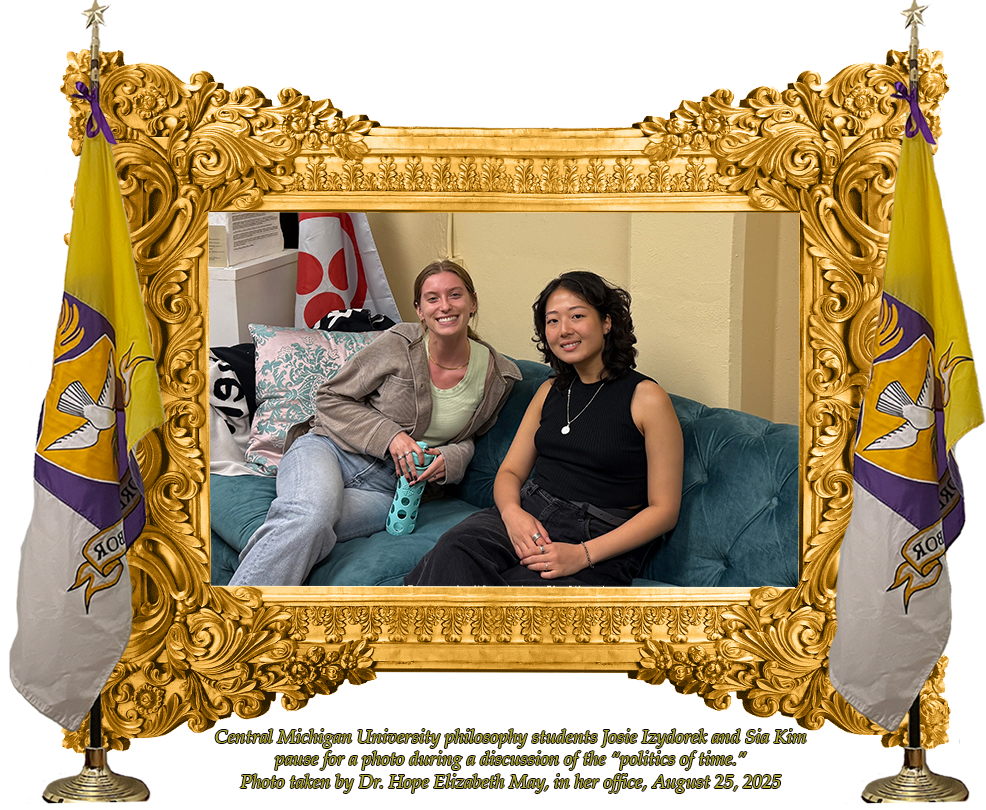

This website arose quite organically on August 25, 2025, the first day of the Fall 2025 semester at Central Michigan University, in a conversation in an "in between" space, neither a formal classroom nor a meeting, but a "gap in time" characteristic of the typical university schedule.
The place? The office of Dr. Hope Elizabeth May ("Hope"). A natural flow brought the three of us, Josie, Sia, and Hope, into Hope's office, and we found ourselves immersed in philosophical dialogue. At some point, the different time keeping systems of East and West came up. Sia, who is from Busan, South Korea, was explaining how the lunar time keeping system of China (adopted in Korea) had, in South Korea, been replaced with the Western Gregorian Calendar. This is of course just one piece of the "Westernization" of South Korea, another being the replacement of the former "King" with a "President" following a controversial U.N. sponsored election in 1948. Hope used the phrase "the politics of time", and Josie asked "is there a website on that ?" Hope explained that she had coined the phrase, and that she would see if the domain name "politicsoftime" existed. Lo! It did, and right then and there Hope purchased this domain for $10.94. She built this site shortly thereafter. Clearly Josie's question pointed to a need for such a site, and this is an effort to address that need.
What is the "Politics of Time?" Well, as most of us no longer anchor time to planetary motion or some other naturally recurring phenomenon, the narrative of "the beginning" is political, as is the "geometry" of time. Where does one "anchor" the beginning? What moment, the birth of Christ, the beginning of some earthly Kingdom, or even a mythological story? Once this is settled, then question of the "geometry" of time remains. Is time a line? Is it a recurring cycle? A spiral?
Consider: the Tibetan calendar begins with the first transmission of the Kalachakra teaching 1027 A.D.. Much later than the Chinese calendar which begins around 4300 B.C. Why is that?
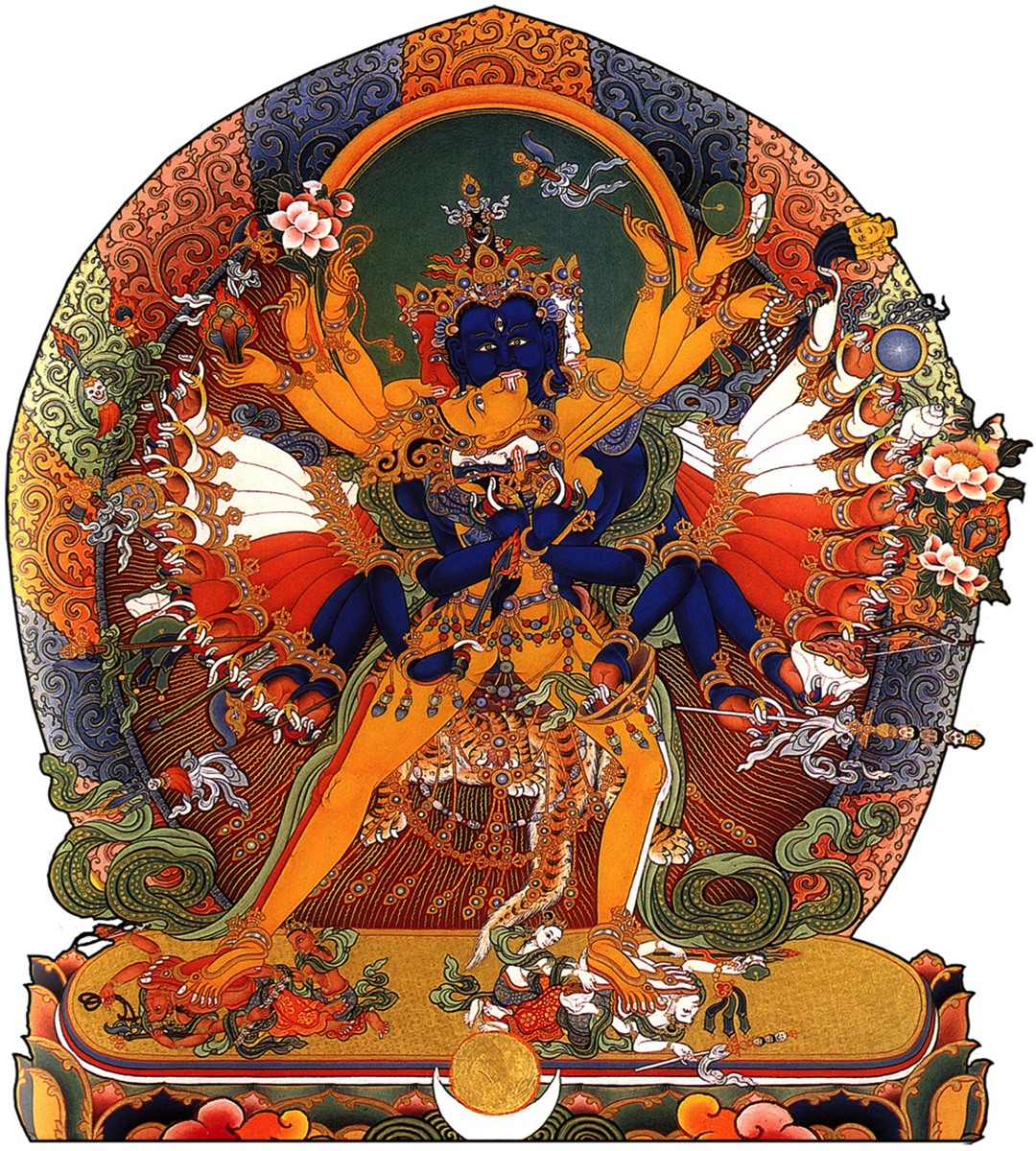
"Kalachakra" means "wheel of time." Originating in India, and transmitted to Tibet in 1027, the bundle concept that is "Kalachakra" includes a complicated teaching about the relationship between "inner time" and "outer time". Lots and lots of study needed here. You can begin by understanding the symbolism of this "bundle image" and "concept map". Then you will need to memorize it. How long will that take you?
For an infographic created by Hope which gives you an "impression" of the Tibetan system of sexegenary (60 year) time cycles, and which required many iterations of her prompts to Chat GPT 5, click here. Work on this infographic continues. It's origin? Another in-between space. It was originally created for a right proper viewing of The Dalai Lama's Gift, with former Central Michigan University philosophy students Randy Olson and Ryley Olson (no relation), at Hope's home on August 16, 2025. We watched the films, and Hope, in her usual fashion, made handouts. These infographics were among them. Work on them continues, first iterations here.
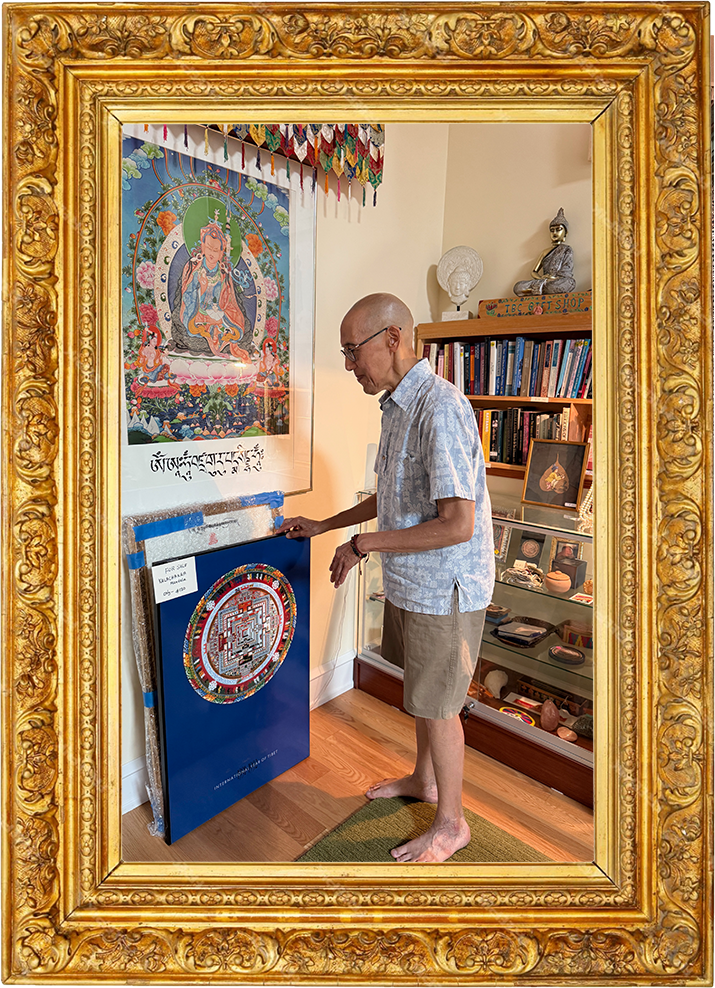
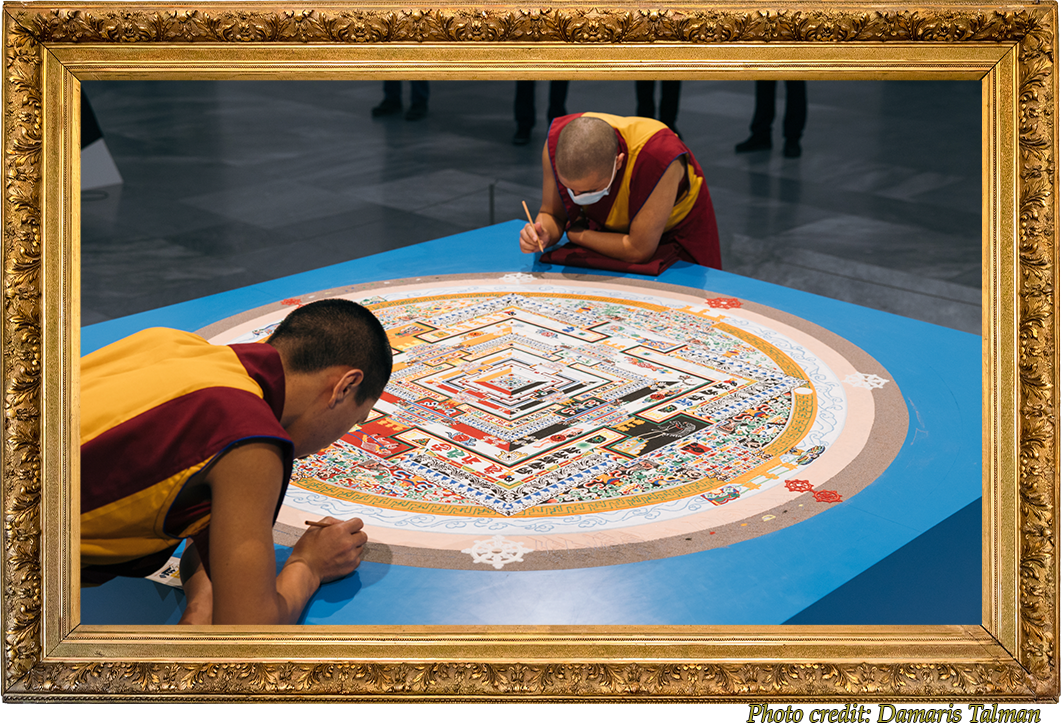
Deepest thanks to Stephen Liu of the Philadelphia Chenrezig Buddhist Center for telling Hope about the film "The Dalai Lama's Gift" when she visited the Center on June 25, 2025, the 75th anniversary of the Korean War. In this photo from that meeting, Stephen shows Hope a poster of the Kalachakra Mandala. What is a Mandala? Again, many things, but for starters we can say that it is a 2-dimensional sand painting of Kalachakra's home or palace. To learn more about the Kalachakra Mandala, click here (text), here (video about sand painting), and/or set the intention to watch The Dalai Lama's Gift, which will require some effort on your part which just might require you to interact with the "real" world.